
Theory of Change
The Girls in Space Program structures its activities based on a Theory of Change that connects education, science, and territory, promoting the development of girls as agents of social and environmental transformation.
This journey takes place progressively, beginning with access to science and leading to the generation of sustainable impact within communities.
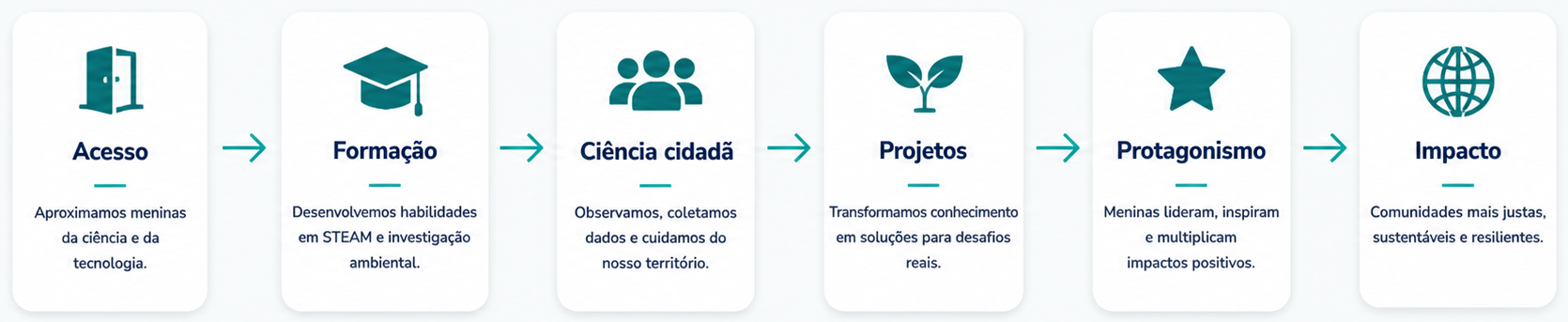
Access
The project’s starting point is expanding access to science and technology for girls, especially those from public schools. Through partnerships with schools and institutions, the program breaks down structural barriers and brings students closer to areas such as STEAM and the aerospace sector, aiming to promote greater inclusion and equity in access to scientific knowledge.
Training
After access is established, the project promotes structured training, based on active methodologies and multidisciplinary content.
Students develop skills in:
- science and investigation;
- technology and programming;
- engineering and innovation;
- sustainability and the 2030 Agenda.
This process aims to develop scientific, technical, and socio-emotional competencies.
Citizen Science
In the third stage, participants begin to act as citizen scientists, investigating real problems within their territories.
They:
- collect environmental data;
- analyze information related to the hydrosphere, atmosphere, and climate;
- participate in scientific protocols (such as GLOBE)
This stage promotes critical understanding of the environment and the development of applied scientific thinking.
Projects
Based on the collected data, students develop scientific projects and practical solutions..
These projects include:
- environmental research;
- development of educational products;
- participation in science olympiads;
- creation of portfolios and reports.
This stage transforms knowledge into real solutions for local challenges.
Leadership
Throughout the process, the girls take on the role of leaders, guiding projects, presenting results, and inspiring other students.
They begin to:
- occupy scientific spaces;
- share knowledge;
- act as multipliers.
This strengthens female leadership in science and technology.
Impact
The final outcome is the generation of social impact, educational, and environmental..
The project contributes to:
- more sustainable communities;
- greater environmental awareness;
- reduction of inequalities;
- strengthening of science education.
The goal is to develop a generation capable of transforming local realities through science.
This structure demonstrates that Girls in Space does not simply teach science; it develops leaders, promotes inclusion, and generates sustainable transformation, aligning directly with the Sustainable Development Goals (SDGs) and international guidelines for education and innovation